Posts

Our Lady of Las Lajas

Image
The miraculous rock-image of Our Lady of Las Lajas Deep in the lush Andean highlands of southern Colombia, near the city of Ipiales, largely hidden in a steep canyon above the swift-flowing Guáitara River, lies a marvellous Gothic-style church known as ' Santuario de Nuestra Señora del Rosario de Las Lajas' or simply Our Lady of Las Lajas ( Nuestra Señora de Los Lajas) This beautiful building houses a remarkable feat of engineering and was built between 1916 and 1949. The stunning church, now a National Shrine Basilica, is a marvel in itself, but the unique image of the Blessed Mother it houses, known as Our Lady of Las Lajas  (“ lajas ” meaning “slab of rock” in Spanish) , has a fascinating story behind it. The first miracle of Our Lady of Las Lajas As the legend goes, on a dark night in September 1754, an Indigenous woman named María Mueses de Quiñones was travelling from the village of Potosi, Colombia, along the Guáitara River with her daughter, Rosita, who was deaf and mu...

Our Lady of Guadalupe

Image
Our Lady of Guadalupe St Juan Diego The story of Our Lady of Guadalupe, or Nuestra Senora de Guadalupe , is a deeply significant part of Catholic and Mexican culture.  It centres around a series of miraculous events in 1531, barely 10 years after the brutal Spanish conquest of the Aztecs, near present-day Mexico City, involving a humble indigenous man named Juan Diego Cuauhtlatoatzin. The Apparitions of the Most Blessed Virgin Mary A poor  57-year-old  Mexican Aztec native named Cuauhtlatohuac,  a widower who lived in a small village near Mexico City,  was baptized and given the name Juan Diego.  On Saturday morning December 9, 1531, he was walking on a hill called Tepeyac (now within Mexico City) to a nearby barrio to attend Mass in honour of Our Lady. He heard beautiful music like the warbling of birds. A radiant cloud appeared, and within it stood an Indian maiden dressed like an Aztec princess.  Juan Diego’s Unlikely Mission The lady spoke to him i...

Chora Church

Image
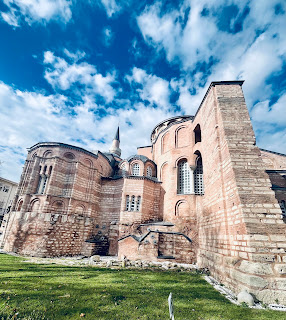
Stunning Byzantine  mosaics and frescoes at Chora Church in Istanbul The Chora Church , also known as Kariye Camii or Kariye Mosque , is an important historical and architectural landmark in Istanbul, Turkey. It was located outside the old city walls of Constantinople, hence the name " Chora ," which means "in the country" or "rural area". Its rich history spans over a millennium and  was initially Stoudios Monastery  from the fifth century ( though the current structure mostly dates back to the 11th century during the reign of Emperor Alexios I Komnenos who renamed it The Church of the Holy Saviour .   It is, by some accounts, the most important monastic foundation of the Byzantine era in Turkey today, and by divine grace, the Mosaics and Frescoes have survived despite years of Ottoman rule, when it was converted to a mosque. Here you  can experience the rare coexistence of Christian and Islamic cultural heritages. The mosaics and frescoes were commissio...

St Paul

Image
In the Footsteps of St Paul Mosiac of St Paul in the St Paul Memorial Museum in Tarsus St Paul is often referred to as the Apostle of the Gentiles. Even though he was not one of the twelve hand-picked by Christ and did not know Christ in the flesh, it did not stop him from being one of the most influential figures in all of mankind to spread the Gospel.  Saint Paul is considered by many to be the second most important Apostle in the history of Christianity, second only to Saint Peter.  And many hold him as important as Saint Peter. That's a bold claim albeit not without merit. On our three-week road trip through Antalia in Western Turkey, we were privileged to walk down some of the very same Roman roads as St Paul did over 2000 years earlier in  Antioch (Antakya), Tarsus (Mersin), Iconium (Konya), Ephesus (Epfe), Miletus (modern Balat, Aydın), Laodicea (Eskihisar), Pergamum (Bergama), Sardis (Sard), Smyrna (Izmir), Philadelphia (Alasehir), Priene (Güllübahçe), Miletus (B...