Apostle and Martyr St Bartholomew
August 24: Feast of the Apostle and Martyr St Bartholomew
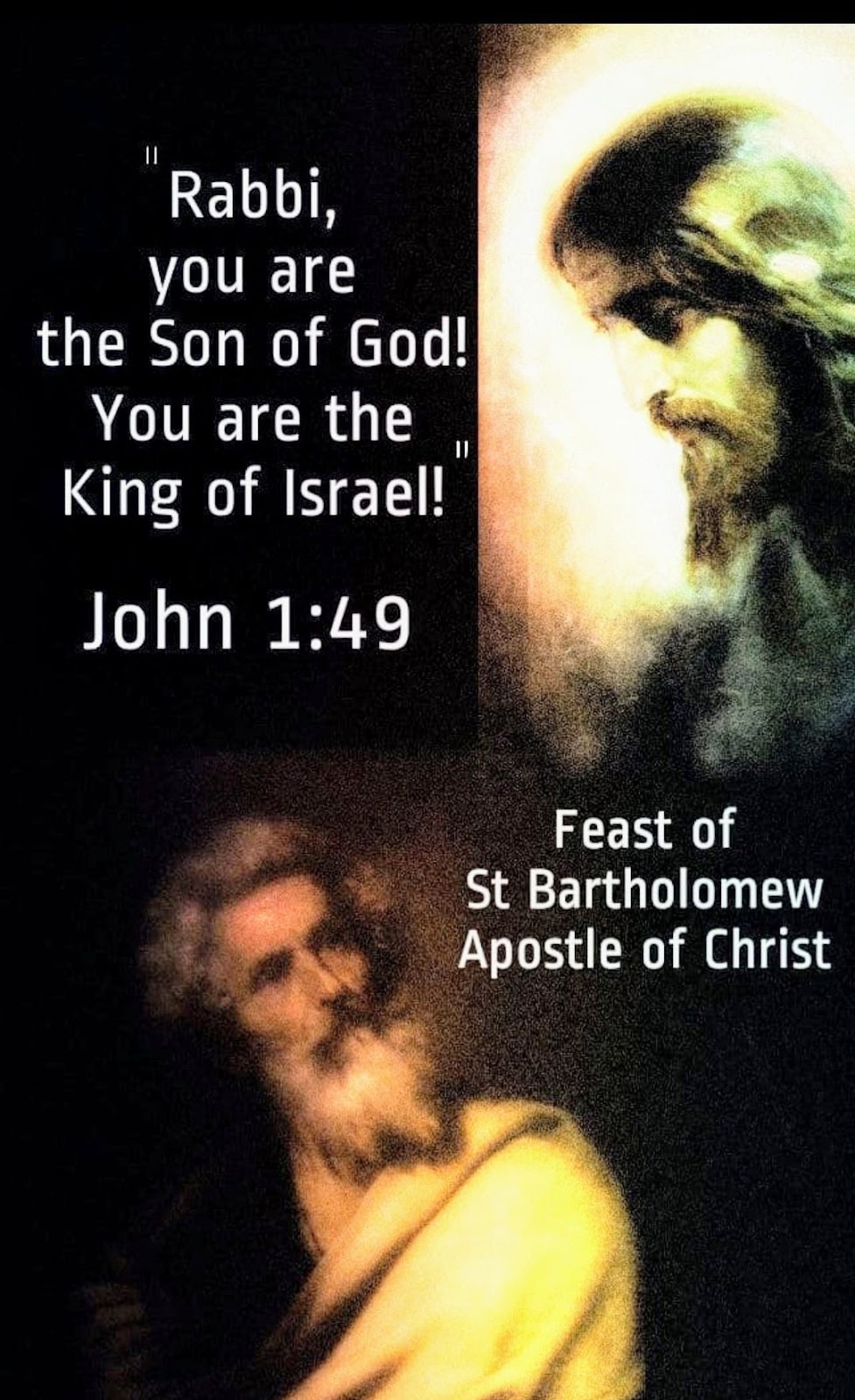
Bartholomew was one of the twelve apostles of Jesus named in Matthew 10:2–4, Mark 3:16–19, Luke 6:14–16, Acts 1:1–13.
The Catholic Church honors Bartholomew as a martyr and saint, and he is the patron of butchers.
The name “Bartholomew” most likely comes from Aramaic (Bar-Talmay), meaning “son of Talmay.” He was born in Cana in Galilee, an area renowned for farming. Some identify him as Nathanael (meaning "God has given"), who appears only in the Gospel of John 1:43-51 when introduced to Jesus by his good friend, the apostle Philip.
Nathanael was sceptical of Jesus because Philip told him he found the Messiah, who came from Nazareth. Nathanael dismissed this saying, “Nazareth! Can anything good come from there?” (John 1:46), but Philip persisted, instead of responding with a sharp comeback he offers a meaningful invitation: "Come and see!".
We are then presented with the Apostle Bartholomew's character in this brief and beautiful dialogue with the Lord Jesus who said, "Here is a true child of Israel. There is no duplicity in him." - reminiscent of Psalm 32:2 which says, "Blessed is the man to whom the LORD imputes no guilt, in whose spirit is no deceit". Jesus declares Nathanael to be a good Jew, honest and innocent, a just man, who devotes much time to quiet reflection and prayer - "under the fig tree (1:48)" - and has been awaiting the Messiah, the Holy One of God., Nathanael proclaims, “Rabbi, you are the Son of God; you are the king of Israel” (John 1:49). In other words Nathanael recognised Jesus as the Messiah. He was lacking "duplicity" - that is, his heart was undivided, his intentions pure - his openness to reality was always ready to recognise and surrender to the truth when he encountered it. Jesus told Bartholomew that he would see great things over the next three years of Jesus' life of public ministry because of his faith. We too are invited to get to know Jesus personally in order to experience God's bountiful grace.
Tradition holds that after the descent of the Holy Spirit on the Apostles at Pentecost, they assigned Peter, James and John to preach in the Holy Land and Rome; the remaining apostles cast lots and Bartholomew was chosen to preach in the Eastern edges of the World, in places like Armenia, Ethiopia, Lycaonia, Mesopotamia, Parthia and India.
The fourth-century historian Eusebius of Caesarea's 'Ecclesiastical History', clearly mentions the mission of the apostle Bartholomew in India. He was said to have left behind a hand-written copy of the Gospel of Matthew. Modern studies of Fr A.C. Perumalil sj and Moraes hold that the Bombay region on the West Konkan coast of India, a region which may have been known as the ancient city Kalyan, was the field of Saint Bartholomew's missionary activities.
He later joined the apostle Judas Thaddeus around 60 AD to bring the good news to Armenia in the first century. Thus both saints are considered the patron saints of the Armenian Apostolic Church.
He is said to have been martyred (according to legend he was skinned alive and beheaded) at a place called Albacus around 68 AD by the order of King Sanatruces of Adiabene (Arbela near Baku in modern Azerbaijan) for having converted Polymius, King of Armenia, to Christianity. Think of the famous scene of the Last Judgement in the Sistine Chapel in which Michelangelo painted St Bartholomew, who is holding his own skin in his left hand, on which the artist left his self-portrait.
His Christians followers buried his body but because of the miracles happening over his relics the pagans threw his coffin into the sea. The coffin ended up at the tiny Italian island of Lipara where Bishop Agathon, who met it via a revelation in a dream, buried it in a church. It is said that this Bishop ordered a group of men to retrieve the body, but that they failed due to its surprising, extreme weight. He then sent out the town's children who, miraculously, quite easily brought the body ashore.
References:


Comments
Post a Comment
Please keep conversations courteous and on-topic. Kindly don’t engage in trolling, flame-baiting, name-calling, insulting, stereotyping or gratuitous attacks. Thank you for being a good citizen.